When engineers spec a motor for a tool, appliance, or compact machine, they’re usually balancing two competing demands: high speed and high torque in a package that stays lightweight, portable, and cost-effective.
That’s exactly where a universal motor shows up in the design conversation. From handheld power tools to everyday appliances, this motor type remains a favorite when manufacturers need serious performance in a compact package. It delivers speed and torque efficiently, even if it isn’t the right choice for heavy industrial duty.
However, for maintenance teams and OEMs, understanding where universal motors shine and where they don’t can prevent misapplications, downtime, and premature wear. This guide breaks down how they operate, why they’re used in specific equipment, and what alternatives to consider when the job calls for something more robust.
At A Glance
Universal motors deliver high speed and strong torque in a compact frame, and they operate on both AC and DC supplies.
They suit portable tools and household appliances but fall short in heavy, continuous-duty, or low-maintenance industrial environments.
Their main strengths include high power density and easy speed control; limitations include brush wear, noise, and lower lifespan.
Induction and brushless motors outperform universal motors in efficiency, longevity, and reliability for demanding applications.
Proper brush care, load matching, and cooling management are essential to keep universal motors operating safely and efficiently.
What is Universal Motors
A universal motor is a type of electric motor designed to operate on both AC and DC power. It uses a series-wound configuration, where the field winding and armature are connected in series, allowing it to deliver very high speed and strong starting torque.
Because of this design, universal motors are compact, lightweight, and capable of running at speeds far higher than most other motor types. This is also the reason why they’re widely used in portable tools and household appliances.
How Universal Motors Work (AC & DC Supply)
A universal motor operates on the same basic principle regardless of whether it receives AC or DC input. Its field winding and armature winding are connected in series, which means current flowing through the motor produces magnetic fields that always interact in the same direction. This lets the motor maintain torque on both AC and DC supplies, the key reason for its “universal” capability.
Operation on DC Supply
When powered by DC, the motor functions much like a traditional series-wound DC motor:
Current flows through the series field and then the armature.
Magnetic fields interact to produce a strong starting torque.
Speed increases rapidly with load reduction, enabling very high no-load speeds.
This makes DC operation smooth, responsive, and ideal for variable-speed control.
Operation on AC Supply
With AC power, the direction of current reverses each half-cycle — but because both the field winding and armature reverse together, torque remains in the same direction.
Key points when running on AC:
Both the armature and field flux reverse at the same time, keeping the torque positive.
Laminated cores reduce the effects of eddy currents and minimize AC losses.
Brush and commutator design manage current switching even under high-frequency reversal.
This enables the motor to run effectively on standard AC mains, though it results in more heat, noise, and brush wear compared to DC operation.
What Dual AC/DC Capability Means in Practice
The ability to run on either supply type gives universal motors:
High versatility for manufacturers
Compatibility with household AC power
Compact design with high-speed output
Strong performance in portable and small equipment
This dual-supply behavior is what makes universal motors unique among small motor types.
Advantages & Limitations of Universal Motors
This table gives a quick, at-a-glance comparison for engineers, OEMs, and maintenance managers, showing exactly where universal motors excel and where they fall short.
Aspect | Strengths | Trade-offs / Drawbacks |
Power & Speed | It can achieve very high speeds (up to 20,000 RPM or more) in a compact size. Strong starting torque is ideal for handheld tools and small appliances. | High speed leads to greater wear and potential overheating if improperly managed. Not suited for continuous heavy loads. |
Versatility | Operates on both AC and DC supplies, with flexibility in design and deployment. | Efficiency is lower on AC due to eddy currents and hysteresis losses. |
Size & Weight | Compact and lightweight, easy to integrate into small machines or appliances. | Smaller size limits thermal capacity; the motor heats up quickly under continuous operation. |
Cost & Availability | Generally inexpensive and widely available for standard tool and appliance applications. | Shorter lifespan compared to induction or brushless motors; frequent maintenance may be required. |
Speed Control | Can be easily controlled using voltage variation or electronic controllers; good for variable-speed applications. | Brushes and commutators require periodic maintenance; more noise and sparking compared to brushless motors. |
Application Fit | Ideal for portable tools, household appliances, and small workshop machinery. | Unsuitable for heavy industrial machinery, pumps, conveyors, or applications requiring high reliability and minimal maintenance. |
Knowing their strengths and limits helps engineers and maintenance teams identify the applications where universal motors truly excel.
Typical Applications Where Universal Motors Excel
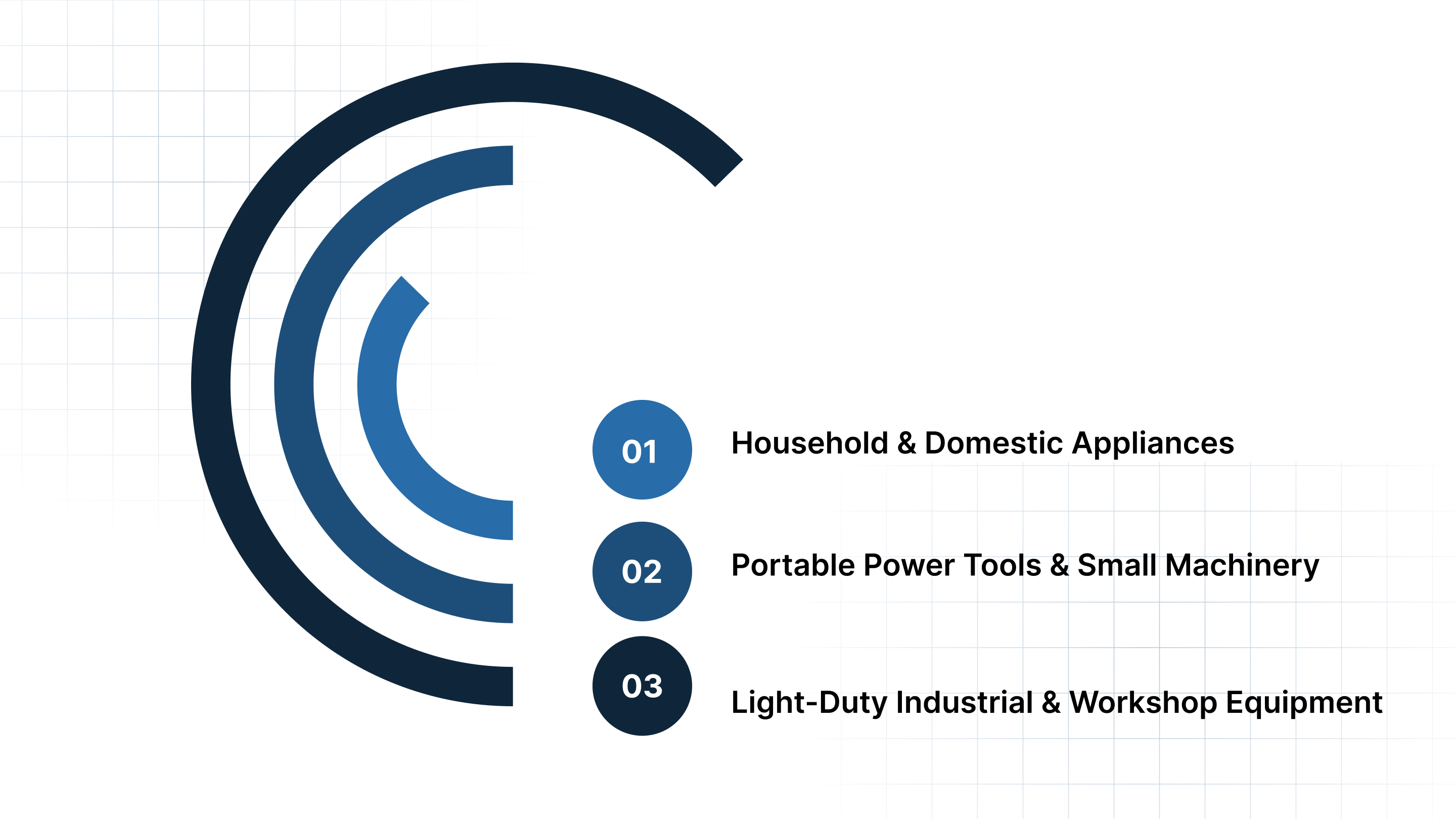
Universal motors are widely used in tools and equipment that require portability, variable speed control, and short-duration operation rather than heavy, continuous-duty use. Key applications include:
Household & Domestic Appliances
These appliances benefit from the motor’s lightweight design and high-speed performance, enabling efficient operation in compact housings.
Vacuum cleaners
Hair dryers
Kitchen mixers and blenders
Sewing machines
Small home tools
Portable Power Tools & Small Machinery
Universal motors provide the torque and speed needed in portable tools, making them ideal for tasks requiring precision and mobility.
Drills, grinders, sanders, polishers
Handheld workshop tools
Light-Duty Industrial & Workshop Equipment
In these settings, universal motors deliver flexible, reliable performance for light industrial tasks without the bulk or complexity of larger motors.
Small machines in workshops or labs
Equipment where variable speed and portability are important
While universal motors excel in many compact and portable applications, they are not suited for heavy-duty, continuous, or maintenance-sensitive operations.
Situations When You Shouldn’t Use Universal Motors
Universal motors are not ideal for every application. Their high speed and compact design come with trade-offs that make them unsuitable in certain environments:
Heavy, continuous-duty industrial loads: Applications like large conveyors, pumps, or compressors require motors built for sustained operation. Induction or brushless motors are typically a better choice.
Noise- or spark-sensitive environments: Universal motors generate more electrical noise and sparking due to their brushes and commutator, which can be problematic in sensitive settings.
Applications needing high reliability and low maintenance: For equipment that must run consistently over long periods with minimal upkeep (e.g., HVAC systems, industrial pumps, heavy machinery), other motor types offer better longevity and dependability.
Not sure which motor type fits your industrial application? Midwest Power Products can help you select the right motor or gearbox based on load, duty cycle, and performance requirements.
Comparing Universal Motors with Other Motor Types
Selecting the right motor often comes down to understanding how universal motors differ from common alternatives like induction motors and brushless DC (BLDC) or permanent-magnet motors. The table below outlines the key distinctions in performance, maintenance, and application suitability.
Criteria | Universal Motor | Induction Motor | Brushless DC / Permanent-Magnet Motor |
Power Source | Operates on AC or DC | AC only | DC / electronic drive |
Speed Capability | Very high (10,000–20,000+ RPM) | Low–medium speed | High speed with precise control |
Starting Torque | High | Moderate–high (depending on design) | High |
Efficiency | Moderate; lower on AC | High | Very High |
Maintenance Needs | High - brushes & commutator wear | Low - no brushes | Very low - no brushes |
Noise & Vibration | High | Low | Very Low |
Durability / Lifespan | Shorter due to mechanical wear | Long lifespan | Long lifespan |
Cost | Low | Moderate | Higher upfront (due to electronics) |
Speed Control | Easy, wide range | Requires VFD for control | Excellent; integrated electronic control |
Typical Applications | Tools, appliances, light-duty equipment | Fans, pumps, conveyors, compressors | Robotics, precision tools, HVAC blowers, premium appliances |
Best For | Compact, portable, high-speed tasks | Continuous-duty industrial loads | High efficiency, low noise, precision applications |
Not Ideal For | Continuous heavy-duty, noise-sensitive environments | High-speed handheld tools | High-heat or extremely low-cost applications |
Once you know how universal motors stack up against other types, the next factor to evaluate is their maintenance and practical operating considerations.
Smart Maintenance & Practical Use Tips for Universal Motors
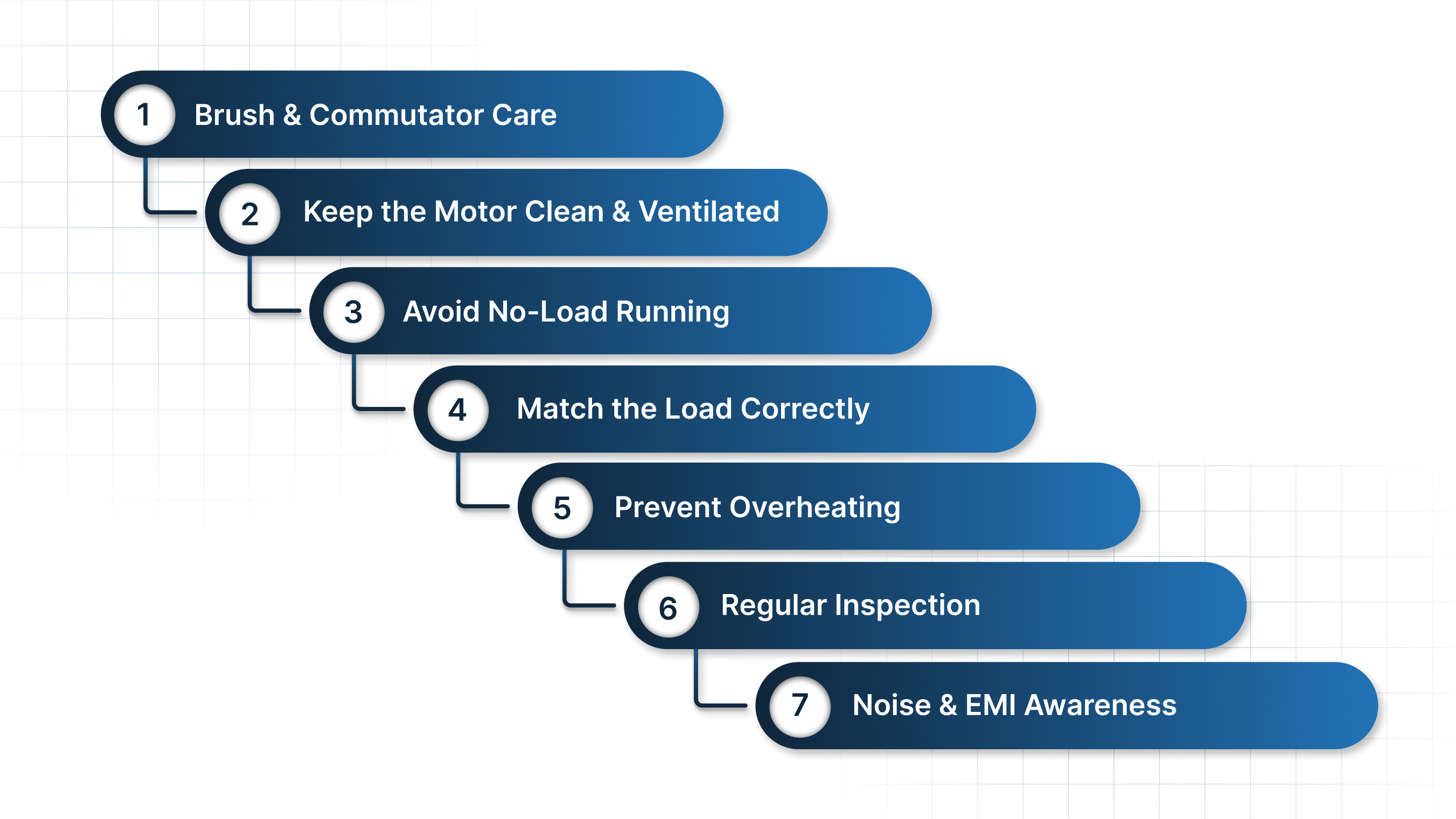
Universal motors can perform reliably when maintained well. Here are the essentials to keep them running smoothly.
Brush & Commutator Care: Brushes wear naturally and need periodic inspection and replacement to prevent sparking, noise, and torque loss.
Keep the Motor Clean & Ventilated: Dust, debris, and blocked airflow increase heat and accelerate wear, so ensure proper ventilation.
Avoid No-Load Running: These motors can overspeed without a load, causing unnecessary stress and reducing lifespan.
Match the Load Correctly: Oversized loads cause overheating, while undersized loads lead to inefficient operation.
Prevent Overheating: Allow cool-down periods during prolonged use and watch for signs of excess heat or a burning smell.
Regular Inspection: Check brushes, terminals, and cooling paths periodically to catch early signs of wear or imbalance.
Noise & EMI Awareness: Universal motors generate noise and electrical interference, so use proper grounding and filters when the application demands it.
If your operation depends on properly matched, well-maintained motors and gearing, Midwest Power Products can help you source reliable units built for your duty cycle and environment. We also provide fast turnaround, same-day delivery, and emergency repair support to keep your equipment running.
Final Thoughts
A universal motor can perform well when its speed traits, maintenance needs, and load behavior match the demands of your equipment. With clear insight into its performance, and when other motor types offer better life or efficiency, you can design systems that run reliably with fewer interruptions.
If you’re reviewing motor options, planning an upgrade, or solving a performance issue, our team at Midwest Power Products can guide the selection process. We support OEMs and industrial users by matching motors and gearing to duty cycles, environments, and performance goals.
Reach out to us today for application support, product sourcing, or fast-turnaround service.
FAQ’s
1. Can a universal motor run at variable speeds without a complex controller?
Yes. Universal motors respond well to simple speed-control methods like triac-based controllers or basic variable-resistance setups, making them easy to integrate into consumer appliances and portable tools.
2. Why do universal motors often have higher noise levels compared to other motor types?
Their high operating speed, brush–commutator arcing, and airflow from internal cooling fans contribute to elevated noise levels. Enclosures and damping materials can reduce noise, but only to a point.
3. Do universal motors require specific protection devices?
Thermal cutoffs, overload protectors, and in some cases EMI suppression components (filters, chokes) are recommended to ensure safe operation and compliance with electrical standards.
4. What factors shorten the lifespan of a universal motor the most?
Frequent stop–start cycles, abrasive dust environments, inadequate cooling, and improper load matching accelerate brush wear and commutator degradation.
5. Can universal motors be reversed easily?
Yes, but reversal requires switching either the field winding leads or the armature leads, not both. This must be done at the wiring level, so it’s typically built into the product design rather than adjusted by the end user.